
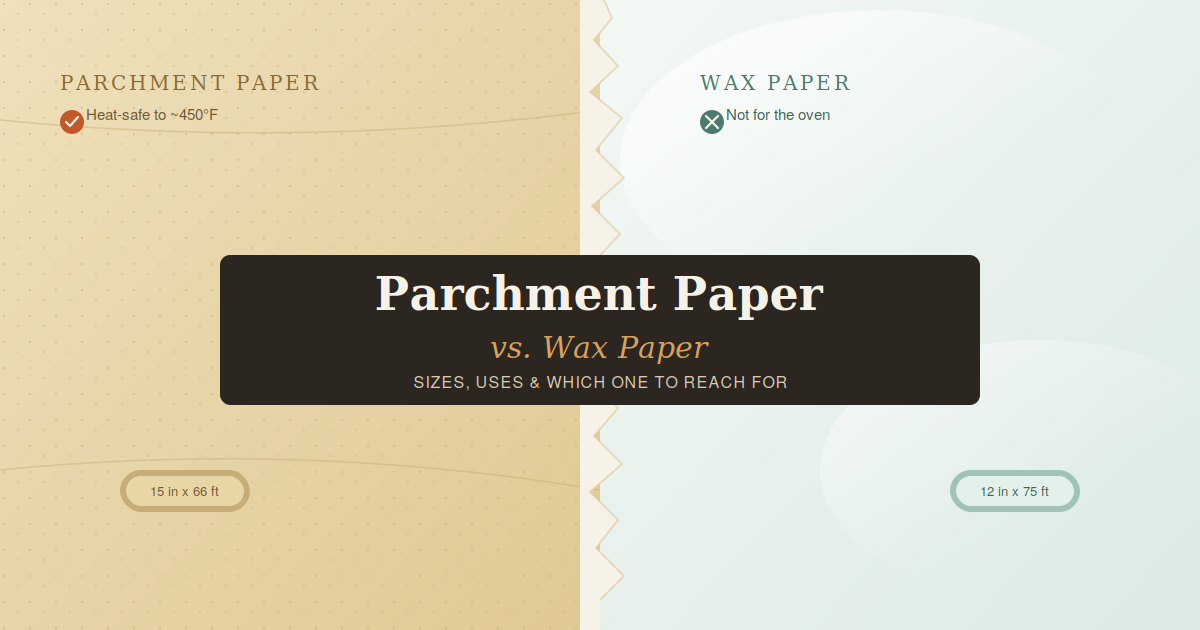
If you’ve ever stood in the baking aisle staring at two nearly identical rolls of paper, you already know the confusion. Parchment paper and wax paper look alike, feel alike, and even come in similar packaging but they are not interchangeable. One is built to survive an oven; the other will smoke and melt if you try.
This guide breaks down exactly what separates parchment paper from wax paper, which sizes each one comes in, and when to reach for which so you never ruin a batch of cookies (or a countertop) again.
What Is Parchment Paper?
Parchment paper is a cellulose-based paper that has been treated with sulfuric acid or coated in silicone. This process, called “parchmentizing,” makes the paper grease-resistant, moisture-resistant, and heat-resistant, typically up to 420–450°F (215–230°C). Because it can handle direct oven heat, parchment paper is a kitchen staple for baking and roasting.
Key characteristics of parchment paper:
- Heat-resistant, oven-safe (check the package for the exact temperature limit)
- Naturally non-stick, so food releases easily without added grease
- Slightly translucent, off-white or unbleached brown in color
- Available in sheets, rolls, or pre-cut rounds
What Is Wax Paper?
Wax paper is regular paper coated on both sides with a thin layer of paraffin wax (or sometimes soybean wax). The wax layer makes it moisture-resistant and mildly non-stick, but it is not heat-resistant. Exposed to direct heat, the wax melts, smokes, and can even catch fire.
Key characteristics of wax paper:
- Not oven-safe under any circumstances
- Water-resistant and grease-resistant at room temperature
- Glossy, slightly translucent surface
- Best suited for cold food prep, storage, and countertop tasks
Parchment Paper vs Wax Paper: Quick Comparison
| Feature | Parchment Paper | Wax Paper |
|---|---|---|
| Oven-safe | Yes, up to ~420–450°F | No |
| Coating | Silicone or acid-treated | Paraffin or soy wax |
| Non-stick | Strongly non-stick | Mildly non-stick |
| Microwave-safe | Yes | Generally yes (check label) |
| Freezer-safe | Yes | Yes |
| Best for | Baking, roasting, air frying, lining pans | Wrapping, layering, no-heat food prep |
| Cost | Slightly more expensive | Slightly cheaper |
Parchment Paper Sizes
Parchment paper is sold in a few standard formats, and picking the right one depends on how you plan to use it.
Rolls
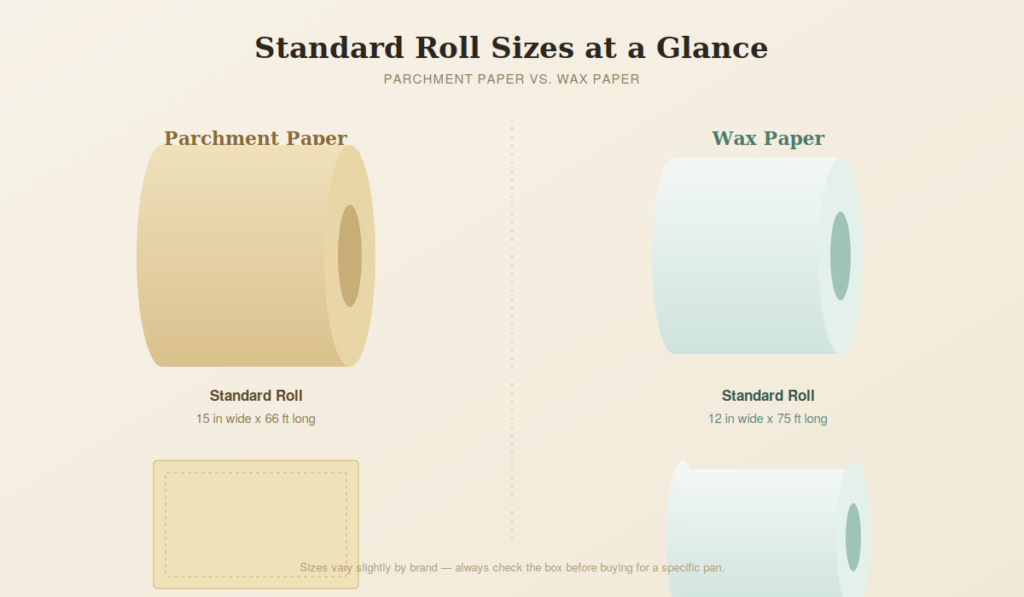
- Standard home rolls: 12–15 inches wide × 25–66 feet long
- Most common consumer size: 15 in × 66 ft (about 71–75 sq ft of coverage)
- Restaurant/bulk rolls: 15 in × 164–205 ft, used with commercial dispenser boxes
Pre-cut sheets
- Half-sheet pan liners: 12 in × 16 in the most popular pre-cut size, made to fit a standard half-sheet baking pan exactly
- Full-sheet pan liners: 16 in × 24 in
- Quarter-sheet liners: 9 in × 13 in
Pre-cut rounds (for cake pans): commonly available in 6 in, 8 in, 9 in, and 10 in diameters.
Pre-cut sheets are worth the slightly higher price if you bake often they lie flat instantly instead of curling up like paper straight off a roll.
Wax Paper Sizes
Wax paper is almost always sold on a roll rather than pre-cut, since it isn’t meant for pan-lining in the oven.
- Standard roll width: 12 inches
- Common roll lengths: 75 ft, 100 ft, and 130 ft (bulk/warehouse sizes)
- Narrower “sandwich” or snack-size rolls: sometimes sold at 10–12 in wide × 25–50 ft for lunch packing
Because wax paper is used for wrapping and layering rather than fitting inside a specific pan, width and length matter more than exact sheet dimensions a wider roll simply means fewer seams when wrapping large items.
When to Use Parchment Paper
- Lining baking sheets for cookies, pastries, and roasted vegetables
- Lining cake pans to prevent sticking
- Wrapping fish or vegetables for en papillote cooking
- Rolling out sticky doughs like pie crust or fondant
- Air fryer basket liners (perforated parchment specifically)
When to Use Wax Paper
- Layering between stacked cookies, burger patties, or cheese slices to prevent sticking
- Lining countertops or work surfaces for candy-making, kneading, or crafts
- Wrapping sandwiches or snacks for storage
- Covering bowls or dishes in the microwave (splatter guard)
- Rolling out non-sticky, no-heat doughs like fudge or truffles
Can You Substitute One for the Other?
Not safely for baking. If a recipe calls for parchment paper and you only have wax paper, don’t put it in the oven the wax coating will melt onto your food and can smoke. For no-heat tasks like wrapping or layering, wax paper and parchment paper can usually be swapped without issue.
Frequently Asked Questions
Is parchment paper the same as wax paper?
No. Parchment paper is treated with silicone or acid to make it heat-resistant, while wax paper is coated in wax and melts under direct heat.
Can wax paper go in the oven?
No. Wax paper is not oven-safe at any temperature and should never be used to line a baking sheet or pan that goes into the oven.
Is parchment paper microwave-safe?
Yes, parchment paper is generally safe to use in the microwave.
What size parchment paper fits a standard baking sheet?
A 12 in × 16 in pre-cut sheet is designed to fit a standard half-sheet pan (roughly 13 in × 18 in) with a small overhang for easy lifting.
Which is cheaper, parchment paper or wax paper?
Wax paper is typically slightly less expensive than parchment paper, since it doesn’t require the additional heat-resistant treatment.
To Summarize
Parchment paper and wax paper solve different problems. Reach for parchment paper any time heat is involved baking, roasting, or air frying. Reach for wax paper for cold food prep, wrapping, and layering. Keeping one roll of each on hand covers virtually every kitchen task you’ll run into.