
Introduction: The Hidden Cost of Stock Packaging
Packaging is often treated as a product protection expense, but for UK e-commerce businesses, it is also a major factor in shipping costs. Choosing the wrong box can increase postage charges, create unnecessary dimensional weight and expose your business to courier surcharges.
A common problem is using standard stock packaging for products that need much less space. A small item packed inside an oversized cardboard box requires additional void fill, more tape and a larger shipping allocation. With some courier services, the parcel’s dimensions can influence the price as much as, or more than, its actual weight.
These additional costs become significant when dispatching hundreds or thousands of orders each month. Even a small saving on every parcel can improve fulfilment margins.
In 2027, businesses looking to reduce e-commerce postage costs UK should prioritise packaging that fits the product, meets Royal Mail’s Pricing in Proportion (PiP) requirements and provides sufficient protection during transit.
The solution is not simply to use smaller boxes. It is to engineer packaging around the product, delivery method and applicable postage category.
1. Cracking the Royal Mail PiP Matrix
Royal Mail’s Pricing in Proportion (PiP) system makes parcel dimensions an important part of postage planning. The principle is straightforward: the size, thickness and weight of an item determine which postal category it qualifies for.
For online retailers, the Large Letter category is particularly valuable because it allows certain products to travel through the postal network without being classified as parcels.
Understanding Royal Mail Large Letter box dimensions
The standard Large Letter limits are:
- Maximum length: 353mm
- Maximum width: 250mm
- Maximum thickness: 25mm
- Maximum weight: 750g for standard 1st and 2nd Class Large Letter services.
These measurements are maximum external dimensions, not recommended internal box dimensions. Your packaging must accommodate the product while remaining within the permitted measurements after assembly.
Small Parcel limits are considerably larger:
- Maximum length: 450mm
- Maximum width: 350mm
- Maximum thickness: 160mm
- Maximum weight: 2kg for standard Small Parcel services.
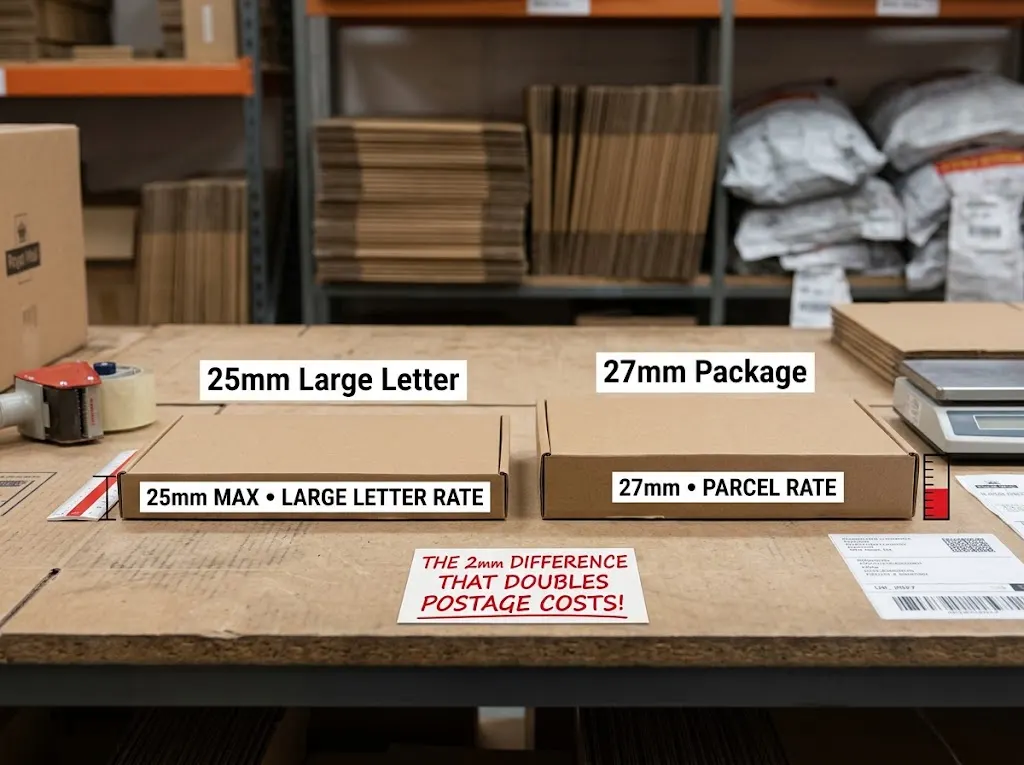
One detail that businesses must understand is the 25mm thickness threshold. If a Large Letter package measures 27mm after packing, it no longer qualifies for that category. It may need to be sent using a more expensive Small Parcel service.
That additional 2mm can therefore create a significant increase in postage expenditure, depending on the service and applicable rate.
For example, a retailer sending 1,000 orders monthly could face an avoidable cost increase if a poorly designed mailer repeatedly pushes products over the Large Letter limit.
Design around the finished parcel
Do not design packaging using internal dimensions alone. Allow for board thickness, folded edges, product movement, protective layers and closure mechanisms.
Measure the finished, sealed package at its thickest point. Also check weight limits because a parcel that meets the dimensional requirements can still exceed its permitted weight.
An important distinction for 2027 planning: Royal Mail’s Large Letter weight allowance varies by service. Standard 1st and 2nd Class Large Letters have a 750g limit, while some other services, including Tracked 24, have different allowances. Always check the relevant service specification before finalising a packaging design.
2. Letterbox Mailers & Eliminating Missed Deliveries
Missed deliveries create additional work for fulfilment teams and inconvenience for customers. Parcels that cannot fit through a letterbox may require a delivery attempt when the recipient is unavailable, followed by collection or rearrangement.
For e-commerce brands selling cosmetics, accessories, stationery, small clothing items and other compact products, slimline packaging can help address this problem.
Custom-engineered letterbox packaging is designed around the dimensions of the product rather than the dimensions of a standard stock box.
A properly designed mailer can offer three commercial advantages:
1. Better postage classification
A slimline mailer can help eligible products remain within the Royal Mail Large Letter limits. This is particularly useful for lightweight products that do not require the depth of a conventional parcel box.
2. Fewer delivery complications
Packaging that meets the customer’s letterbox dimensions can make unattended delivery more practical. However, no packaging design can guarantee successful letterbox delivery because mailbox dimensions, access restrictions and carrier procedures vary.
3. More efficient fulfilment
Custom-sized mailers reduce unnecessary packaging material, simplify packing operations and help businesses maintain consistent parcel measurements.
Choosing the right custom mailer
The most suitable design depends on the product, its fragility and the delivery category you want to achieve.
For compact products, consider rigid or folding letterbox mailers with carefully designed closures. For products requiring additional protection, use a suitable corrugated construction without adding unnecessary thickness.
Businesses purchasing letterbox custom mailers wholesale UK should provide their supplier with the product dimensions, packed weight and target postage category before approving production.
Product Boxes UK offers a range of custom mailer boxes that can be developed around different product sizes, branding requirements and fulfilment needs.
Subscription businesses can also benefit from appropriately sized custom subscription boxes. These allow brands to maintain a consistent presentation while controlling the external dimensions of recurring shipments.
The objective is to make every millimetre of packaging serve a purpose.
3. Material Selection: Strength Without Volumetric Weight
Reducing packaging dimensions should never come at the expense of product protection. A box that arrives damaged can cost more through replacements, refunds and customer service than the postage savings it initially created.
The key is selecting a board grade that provides sufficient strength without adding unnecessary weight or bulk.
E-flute corrugated board versus double-wall packaging
E-flute corrugated board is a practical option for many lightweight e-commerce products. Its relatively fine flute profile provides a useful balance between cushioning, rigidity and a compact external profile.
It is suitable for applications such as:
- Small retail products and accessories.
- Cosmetics and personal care packaging.
- Lightweight electronics and components.
- Subscription products and gift sets.
- Small branded e-commerce shipments.
Double-wall corrugated board contains two fluted layers and is generally more appropriate for heavier, fragile or higher-risk shipments. However, using it for every order can add unnecessary material, increase packaging weight and reduce the available internal space.
The correct choice depends on the product’s weight, fragility, stacking requirements and expected handling conditions.
Use custom inserts to eliminate wasted space
Custom inserts are another effective way to reduce shipping dimensions. Instead of filling an oversized box with loose paper, bubble wrap or excess protective material, a fitted insert holds the product in a defined position.
This approach can:
- Prevent products from moving during transit.
- Reduce the need for excessive void fill.
- Support smaller external box dimensions.
- Improve presentation when customers open their orders.
- Help standardise packing procedures.
For businesses handling multiple product variations, customised inserts can also make packing more consistent.
Product Boxes UK’s Custom Inserts, Tissue & Tape range provides options for developing packaging components around individual fulfilment requirements.
The aim is to specify the lightest suitable construction that passes practical transit testing. Packaging should be tested with the actual product, including drop, compression and vibration considerations where relevant.
4. Securing Parcels with Recyclable Tape
Packaging efficiency does not end when a product is placed inside its box. The closure method also affects security, presentation and material compatibility.
Traditional plastic packing tape is widely used, but it introduces a different material into otherwise paper-based corrugated packaging. This can complicate recycling because the tape may need to be separated during processing.
Water-activated paper tape offers an alternative.
It uses a water-based adhesive that bonds with the paper fibres of corrugated board. Once applied correctly, it creates a strong seal and can provide visible evidence if someone attempts to open the parcel.
Why consider custom water-activated tape?
For businesses shipping branded orders, paper tape provides several advantages:
- Strong carton closure: The adhesive forms a bond with the corrugated surface.
- Tamper visibility: Attempts to remove or disturb the tape can leave visible evidence.
- Brand presentation: Company logos, brand colours and messages can be printed directly onto the tape.
- Paper-based packaging: It supports a more consistent paper-based packaging specification.
Businesses looking for custom water-activated tape can customise the printed appearance to match their shipping boxes.
However, recyclability depends on the tape adhesive, board construction and local recycling facilities. Water-activated paper tape is generally compatible with paper recycling when the complete packaging system is accepted by the relevant facility. It should not automatically be described as making every parcel 100% recyclable.
For suitable applications, it provides a practical way to combine secure sealing, professional branding and more consistent packaging materials.
5. Summary Table & Actionable Checklist
The following table provides a starting point for selecting packaging around Royal Mail’s standard size categories. Suggested box dimensions are design targets, not official postage limits.
| Postal category | Maximum dimensions | Suitable packaging |
|---|---|---|
| Large Letter | 353 × 250 × 25mm; 750g | Slimline mailers, suitable folding board |
| Small Parcel | 450 × 350 × 160mm; 2kg | E-flute corrugated boxes |
| Medium Parcel | 610 × 460 × 460mm; 20kg | Appropriate single or double-wall board |
Before changing your packaging specification, use this checklist:
- Measure products and finished parcels accurately.
- Identify the cheapest suitable delivery service.
- Design around external postal dimensions.
- Compare E-flute and stronger board grades.
- Use fitted inserts instead of excessive void fill.
- Test packaging under realistic transit conditions.
- Review courier invoices for dimension and weight adjustments.
- Recheck Royal Mail’s latest service limits and 2027 prices.
6. How to Build a More Cost-Efficient Shipping Strategy in 2027
Reducing postage costs requires more than negotiating lower courier rates. Businesses should review their packaging specifications alongside their fulfilment and delivery data.
Start by identifying your most frequently dispatched products. Compare their packed dimensions, actual weight and postage category. If several products use the same oversized stock box, consider introducing a small range of product-specific packaging sizes.
For example, if a product currently ships as a Small Parcel but can safely fit into a Large Letter mailer, calculate the potential saving across your monthly order volume.
Use this simple calculation:
Monthly postage saving = Number of eligible shipments × Saving per shipment
If 1,000 monthly orders each save £1 in postage, the potential annual saving is £12,000 before accounting for packaging redesign, production and material costs.
Also review courier invoices regularly. Look for weight discrepancies, dimensional adjustments, additional handling charges and seasonal surcharges. These records can identify where a packaging change will have the greatest financial impact.
Final Thoughts
For UK e-commerce businesses, packaging is an operational decision that directly affects delivery costs, customer experience and fulfilment efficiency.
Understanding Royal Mail PiP packaging sizes UK, selecting suitable lightweight corrugated materials and investing in correctly sized custom mailers can help prevent avoidable postage expenditure.
In 2027, businesses should prioritise packaging that protects products, fits the intended delivery category and uses materials efficiently. A carefully designed packaging range can reduce unnecessary shipping volume while maintaining the professional presentation customers expect.
Product Boxes UK helps businesses develop customised packaging solutions for retail, subscription and e-commerce deliveries. Choosing the right packaging specification is a practical starting point for building a more efficient shipping operation.
Editorial accuracy notes before publishing
A few important technical points should be retained when publishing this article:
- Royal Mail weight limits: The 750g Large Letter limit applies to standard 1st and 2nd Class services. Other services have different limits. Royal Mail currently lists a 1kg Large Letter allowance for Tracked 24.
- 2027 postage prices: Do not publish 2026 prices as 2027 rates. Update the article when Royal Mail releases its applicable 2027 price guide.
- The 2mm difference: A parcel exceeding 25mm thickness moves outside the Large Letter category, but the actual postage increase depends on the service selected.
- Letterbox delivery: Slimline packaging improves the potential for letterbox delivery but cannot guarantee it.
- Recyclability: Avoid an unconditional 100% recyclable claim without confirming the complete packaging specification and relevant recycling requirements.
Authoritative references
These sources support the postal measurements and courier-pricing explanations: